
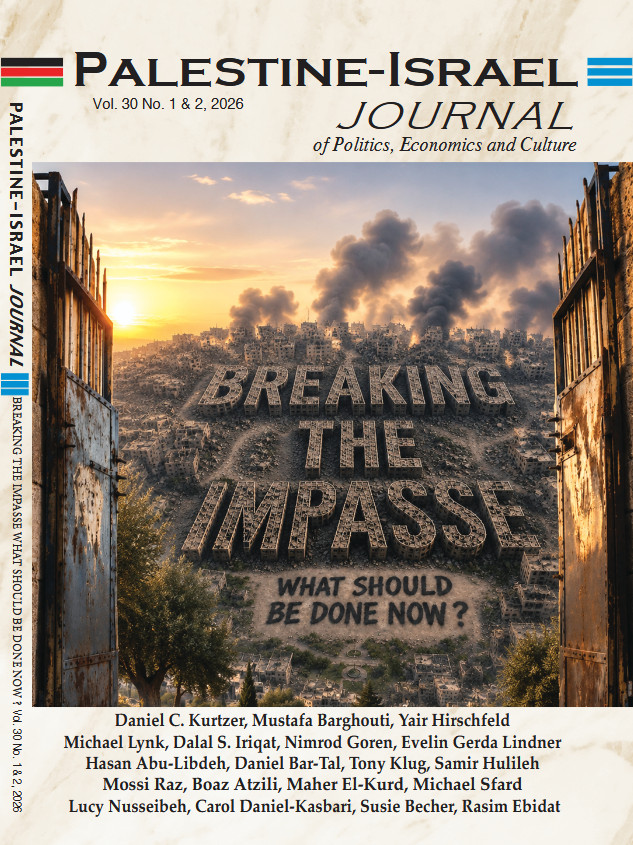
It was not long after the outbreak of the Gaza war that pundits started writing about “the day after.” Something earthshaking had taken place, and they believed the Israeli-Palestinian conflict would never again look like it did prior to October 7. Day-after plans largely focused on regional integration, Gaza reconstruction, reforming the Palestinian Authority and holding elections, and international support for a regional approach to the two-state solution.
The third anniversary of October 7 is almost upon us, but the day after keeps moving further away, and the assumption that the Palestinians can be kept in a state of purgatory is disturbingly reminiscent of October 6. The only plan on the table is Trump’s 20-point plan, which is gathering dust while the Israeli army slowly pushes the Yellow Line and the Gazans who live to the west of it toward the sea. Settlement in the West Bank, which is not even mentioned in the Trump plan, and the Israeli Government’s transfer of
administrative authorities meant to erase the distinctions between Areas A, B, and C are progressing with no more than the usual expressions of concern from Europe. The totality of the occupation is no longer addressed. Gaza has overtaken the West Bank in the news cycle and in people’s minds, and they are usually spoken of as two separate areas with distinct challenges.
When it comes to Gaza, the immediate focus is on humanitarian aid and Hamas disarmament. A governance vacuum has been created as a result of Israel’s opposition to allowing the Palestinian Authority to play a political role, the inability of the National Committee for the Administration of Gaza to enter the Strip, the establishment of a farcical “Board of Peace” which Western powers have declined to join, and by the unsurprising failure to raise the funds needed to make the system operational.
As for the West Bank, international attention has homed in on settler violence, with the EU and other European countries imposing sanctions on the perpetrators. Even Israelis who support the settlement enterprise have condemned them, and recently dozens of high-ranking former officials issued a “final warning” to the Netanyahu government, threatening to appeal to the Supreme Court if no action is taken.
The urgency of providing humanitarian aid to Gaza is unquestionable, as is the need to protect Palestinians in the West Bank from the scourge of settler “violence” or, more precisely, settler terrorism. Making Gaza livable, however, is not a replacement for making it free, and sanctioning violent settlers is not a replacement for putting an end to what the International Court of Justice has established is an illegal occupation of all the territory captured in 1967. Many NGOs are doing praiseworthy work in these areas, supporting aid delivery and providing protective presence to Palestinians under threat. Those are life-saving activities, but they do not bring us closer to the day after — neither the day after the Gaza war nor the day after the occupation.
A Diplomatic Void
On the diplomatic front, last year witnessed a wave of recognition of the State of Palestine, when close to a dozen countries, including such major European powers as France and the UK, recognized Palestine as a sovereign nation, bringing the total number of UN member states that recognize Palestine to 157. Additional countries, such as Italy and the Netherlands, are said to be wavering and may follow suit. On the ground, however, recognition has changed almost nothing, and many Palestinians dismiss it as a symbolic gesture meant to create the impression of action when in effect there has been no follow-through. Perhaps the main impact of recognition was to anger the Israeli authorities, but even that has subsided. While bilateral relations with Norway, Ireland, and Spain sharply deteriorated after they became the first European countries in a decade to recognize Palestine, recognition by France, the UK, Canada, and others in September 2025 was condemned by the Israeli Government and met the usual accusations of rewarding terrorism, but no harsh diplomatic moves were taken.
In October 2025, President Trump’s 20-point plan was released. Hailed by many as a peace plan, it is actually a plan for a ceasefire arrangement between Israel and Hamas, and in that it has achieved some success. All the living Israeli hostages were freed and the bodies of the dead returned, some 2,000 Palestinian prisoners were released, the Israeli army withdrew to the Yellow Line, and the massive killing of Gazans stopped. It is true and quite concerning that the IDF has since advanced so that it now controls some 70% of the Strip, that approximately 1,000 Gazans have died since the ceasefire took effect, and aid deliveries have not reached the agreed levels, but the situation is better than it was prior to October 10, 2025. What is missing from the Trump plan is the endgame of an independent, sovereign, viable, contiguous Palestinian state alongside the State of Israel. Yes, I am familiar with the 19th point in the 20-point plan, with Article 2 of UNSC Resolution 2803, and with the well-intentioned people who try to convince themselves and others that there is a promise of Palestinian statehood in these documents. Unfortunately, the conditionality in the resolution is far greater than the promise, and it references previous onesided proposals such as the 2020 Peace to Prosperity plan, which offered the Palestinians autonomy in the guise of liberation. Furthermore, by enabling the passage of the resolution, France undermined the progress it had achieved with the United Nation’s endorsement of the New York Declaration and the wave of recognition of the State of Palestine. Unlike resolutions of the General Assembly, UNSC resolutions are binding, making it difficult to escape the limited scope of 2803 and the dysfunctional governing apparatus it created.
One wonders whether the members of the UNSC would have approved the creation of the so-called Board of Peace if at the time they had known that its charter would define its mandate as applicable to conflict areas around the world, that membership would be solely at the discretion of Donald J. Trump, that states would be able to purchase permanent membership, that all substantive decisions would be subject to Trump’s approval, that all amendments to the Board’s charter would be subject to Trump’s endorsement, and that Trump would be the final authority for the resolution of any international disputes, and that Benjamin Netanyahu and Vladimir Putin — two leaders indicted for war crimes — would be invited to join. Had the Western countries that woke up to reality at the Davos summit in January 2026 shown greater courage a few months earlier, they might well have pressured the other members of the UNSC to thwart the passage of the resolution. Instead, they later chose not to join the Board of Peace, diminishing its stature and consequently contributing to Trump’s dwindling interest in it but failing to propose an alternative.

No Need To Reinvent the Wheel
So where does that leave us? At the moment, there is no peace plan on the table, although there is no shortage of operable plans on implementation of the two-state solution, most of which were drafted at the beginning of the century yet remain relevant today. There is no need to reinvent the wheel. With the understandings reached by Prime Minister Ehud Olmert and President Mahmoud Abbas as the starting point, the Clinton parameters and the Arab Peace Initiative providing a framework, the logistical details worked out by civil society actors such as the Geneva Initiative and Shaul Arieli filling in most of the blanks, and the UN-endorsed New York Declaration accounting for the changes since the earlier plans were drafted, all that is missing are two leaders prepared to sit at the table and sign on the bottom line. And therein lies the rub.
Mahmoud Abbas is ready, but he has become a controversial leader in the eyes of his people because two decades have passed since presidential and parliamentary elections were held in the PA. The Palestinian public is calling for democratic, fair, and free elections whose outcome will grant legitimacy to the leadership. Meanwhile, Abbas’s authorities are being undermined by the architecture established by Trump for governance of the Gaza Strip.
On the Israeli side, the refusal of the current government to even contemplate anything other than total control, if not total conquest, of all of the Palestinian territory is well known. The problem is that the majority of the Israeli public is deluding itself into believing that a new government will be able to achieve a livable status quo, at least to the west of the Green Line. If Netanyahu is indeed defeated, however, we will end up with an Israeli Government led by a gentlemanly, liberal right-winger who believes in equality for the LGBTQ community though not for Palestinian citizens of Israel, a progressive who will halt the judicial overhaul without acknowledging that democracy and occupation don’t go hand in hand. He will not be a naysayer; he will be a smooth talker who will offer security now and peace in the future, “when the Palestinians turn into Finns.”1
There is no telling how the U.S. administration will react to such a prime minister. It is quite possible that by the time the elections in Israel take place, President Trump may have shifted his attention to a different hemisphere. But even if he hasn’t forgotten the development potential along the Gaza coast, it is not Palestinian independence but rather the Trump family coffers that will be driving his decision making. As for Europe, the likelihood is that it will not want to rock the boat and will welcome the opportunity to dance with a leader who talks the talk even if he doesn’t walk the walk. Plans will be drafted, visions will be extolled, processes will be rolled out, some restrictions will be lifted, confidence-building measures may be taken, and negotiations may even be held, but an agreement that ends the occupation and establishes a truly sovereign Palestinian state alongside the State of Israel will not be signed.
Empty Promises Can’t Compete With Martyrdom
Improvements in the daily lives of Palestinians will surely be welcomed, especially by parents of young children whose primary responsibility is to keep them housed, fed, and educated. But picture the 15-year-old Palestinian who has lost at least one relative, who has no citizenship, who cannot go to school without crossing checkpoints where soldiers are free to mete out as much abuse as they like, who goes to sleep knowing marauding settlers could set fire to the family home during the night, who may be detained or wounded or shot dead for making a sudden movement or looking sideways, who cannot imagine going to college, earning a degree, having a career, and raising a family. What does European recognition of the State of Palestine mean to this teenager? What hope do visions, processes, promises, steps, and measures hold for such youth? How can the possibility that a credible pathway toward Palestinian statehood will be launched at some undefined future date compete with the instant glory of martyrdom in the name of the liberation of the Palestinian people for that 15-year-old who has nothing to lose?
The time has come to face the fact that we are nowhere near the day after. The intensity of the conflict may vary, its impact on Palestinian lives may differ in severity, its presence in the lives of Israelis may fluctuate, but its resolution is not being discussed. Resolution, however, is the only answer to the question of what’s next.
There is no time to lose. An answer is owed to the Israeli children whose lives have been upended in the aftermath of October 7. Yet difficult as their struggles may be, they are privileged in the number of options open to them in comparison with the 15-year-old Palestinians in Gaza or the West Bank. Their patience with horizons has run out. Their belief in the system — Hamas, the Palestinian Authority, the Israeli Government, the White House, the EU, the UN, the Arab League — has been destroyed. If they don’t see immediate action, what’s next for them is a “credible pathway” to martyrdom. The only question is how many Israelis will they take along with them?
No Room for Failure
So, what’s next for the Israelis, Palestinians, and members of the international community who want to save the Palestinian teenager from a descent into violence? First, the various plans must be merged into one coordinated implementation mechanism, as proposed in the Paris Call for the Two-State Solution issued by civil society organizations to the leaders of the G7 on June 12. A timeframe must be established that sets December 2028 as the deadline for implementation. Preparations should begin immediately for the convening of an international conference to launch negotiations on the details not addressed in the framework agreement. The conference would take place in December 2026, following but regardless of the outcome of the Israeli elections and hopefully after Palestinian elections as well, but not contingent upon them. Key Arab states would be in the room, not as facilitators but as partners to the discussions.
The wording of the invitations sent to the Israeli and Palestinian leaders should make it clear that they are a summons and that attendance is mandatory. No is not an answer, and failure is not an option. Opening the door to a life of dignity, freedom, and prosperity for the 15-year-old Palestinian by the time he reaches adulthood must be the next move, and it must happen now. Any other scenario will be written in blood.
---------------------------------------------------------------------
1 In an interview with Haaretz in 2004, Dov Weissglas, chief of staff to Prime Minister Ari’el Sharon, asserted that the plan to disengage from Gaza was designed to prevent the establishment of a Palestinian state, remarking that no further political process would be undertaken “until the Palestinians turn into Finns.”