
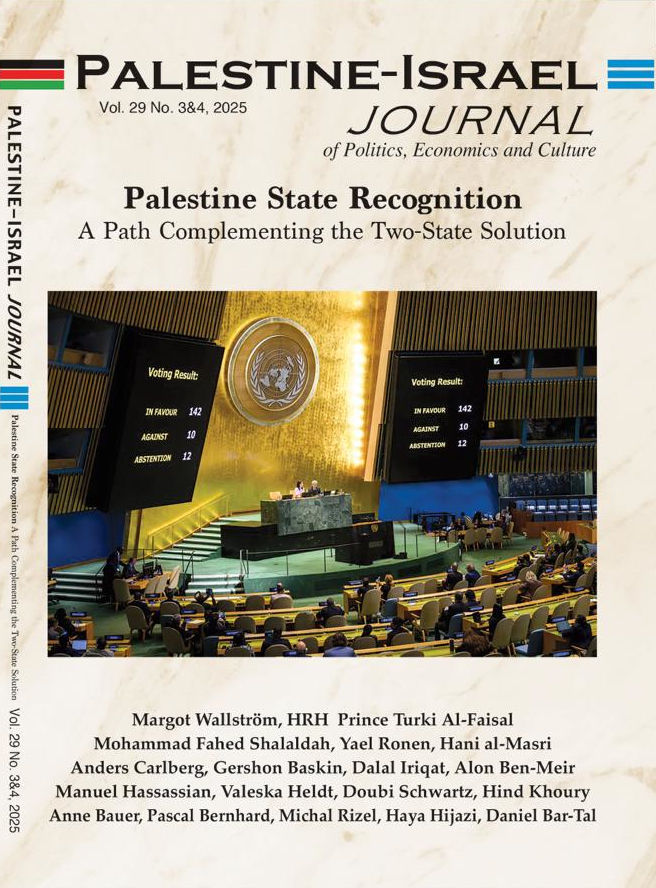
The two-state solution is back on the table. Until now, a Palestinian state has been recognized by 147 countries. France, the UK, Canada, Australia, and Malta, possibly joined by New Zealand, Portugal, and other countries, have declared they will do so in September at the United Nations General Assembly meeting in New York.
Israel is Calling This a “Diplomatic Tsunami.”
Influenced by the horrific, ongoing tragic war in Gaza, the international community, with one notable and important exception, has decided that such a declaration will help to signal an international desire to end the war and make progress toward a resolution of the Israeli-Palestinian conflict.
But is a two-state solution still possible? There are those who argue that the anger that Israelis and Palestinians feel toward each other after the horrific Hamas attack on October 7, and the disproportionate horrific Israeli response has made the prospect of any Israeli-Palestinian peace agreement impossible for generations to come.
When it comes to the practicalities of a two-state solution, many argue that the continuing expansion of settlements in the West Bank, with 750,000 settlers living over the internationally recognized Green Line, along with the building of new settlements and the grabbing of more and more Palestinian lands, makes such a solution impossible, considering that the Palestinians say that their state should be based on the West Bank and Gaza Strip, with East Jerusalem as its capital.
I will try to provide answers here to each of these questions.
Israeli and Palestinian Trauma and Anger
Both Israeli and Palestinian societies are suffering from an extreme case of trauma. The Israelis’ sense of security was shaken by the October 7 attack by Hamas that killed 1,200 people — the overwhelming majority civilians — in the worst tragedy in Israeli history. Many are haunted by images of pogroms in pre-World War I Eastern Europe and of the Nazi Holocaust which killed one-third of the Jewish people. Palestinians are shocked by the disproportionate and extremely violent Israeli response, which has killed over 62,000 people, and damaged or destroyed 70-80% of the buildings in Gaza, including schools, universities, hospitals, and cultural and religious institutions. References are frequently made to the 1948 Nakba (catastrophe) which led to the displacement of 750,000 Palestinians from their homes in the nascent State of Israel, and consider this a second Nakba.
Given this sense of trauma and anger toward the other, how is it possible to imagine a peace process between the two peoples based on a two-state solution?
When we prepared a special issue of the Palestine-Israel Journal in 2017, devoted to “Lessons from the Northern Ireland Peace Process” for Israelis and Palestinians, my colleague Ziad AbuZayyad and I went on an intensive four-day study tour of Dublin and Belfast, meeting with many of the players in the process: https://www.pij.org/journal/89. One of the primary lessons that I learned was that one of the main elements that laid the basis for the 1998 Good Friday Agreement that ended the violence was the factor of fatigue. Both sides in the ongoing conflict, the Republicans and the Loyalists (the Catholics and the Protestants), had become exhausted by the endless violence between them.
Hopefully, Israelis and Palestinians have reached such a state of fatigue in the wake of this terrible mutual tragedy. According to a wise expression attributed frequently to Albert Einstein though there is no evidence that he ever said it: “The definition of insanity is doing the same thing over and over and expecting different results.”
This will require a change in leadership on both sides. Netanyahu and his coalition are clearly not candidates for a change in policy, and the next elections will be critical in terms of creating an alternative Israeli leadership that would be open to change policy. It’s true that the alternative leading candidate, Naftali Bennett, has not signaled any readiness to consider a two-state solution, though another leading candidate, former IDF Chief of Staff Gadi Eisenkot, is more ambivalent. However, any potential right center-left coalition would include factors like Yair Golan’s Democrats Party and Yair Lapid’s Yesh Atid party that have expressed support for a two-state solution, as have all four predominantly Arab parties — Hadash, Ta’al, Ra’am, and Balad — who may run together in the next elections as a Joint List the way they did in 2015.
On the Palestinian side, it’s hard to see Hamas accepting a two-state solution, though some of its leaders, including Khalid Mishal, announced in the past that the movement will accept a long-term hudna (ceasefire) and a Palestinian state alongside Israel, which is seen as an attempt to compromise on acceptance of the two-state solution. Meanwhile, the PA leadership, which officially supports a two-state solution, has lost its credibility. Thus, the new elections promised by President Abbas would be a key to creating a legitimate Palestinian partner.
One thing that is clear is that “managing the conflict” will not be a serious option, and decisions will have to be made.
Do the Settlements End the Possibility of a Two-State Solution?
The fact that there are at least 750,000 settlers living over the internationally recognized border known as the Green Line is frequently cited as making it impossible to establish a Palestinian state alongside the State of Israel.
However, the Israeli expert on the settlement project, Dr. Shaul Arieli, a colonel in the army who served as the Head of the Administration for a Permanent Status Agreement in the government headed by Ehud Barak (1999-2001), disagrees. He asserts that the settlement project has failed in its attempt to prevent the establishment of a Palestinian state. Arieli points to data released by the Israeli Central Bureau of Statistics which shows a negative balance of Jewish migration in the West Bank in recent years, with more settlers moving out of the area than moving to it. Nonetheless, Arieli notes that the number of settlers continuing to increase because of natural growth.
The Palestinians are seeking a state based on the West Bank and Gaza Strip, with East Jerusalem as its capital. The 2002 Arab Peace Initiative supported by 54 Muslim states, members of the Organization of Islamic Cooperation, including all 22 Arab states and the PLO, offered Israel full peace and normal relations based upon its agreement to the establishment of a Palestinian state on those lines, together with an agreed upon solution (with the Israeli Government) to the refugee problem. That proposal was amended during the Israeli-Palestinian negotiations carried out under U.S. Secretary of State John Kerry in 2013-14 to include the concept of a 1:1 land swap. The Palestinian negotiators accepted that concept, leaving the question of the dimensions of the swap. Should it constitute a total of 4-5% of the land adjacent to the Green Line, that would include approximately 80% of the settlers, neutralizing the problem to a great degree. That refers to those living in the Jewish neighborhoods established in East Jerusalem after 1967, which account for approximately 200,000 of the settlers. It would also include Modi’in Elite (approximately 81,000) and Betar Elite (approximately 65,000), the two largest settlements which are adjacent to the Green Line and were built for the ultra-Orthodox, as well as the Gush Etzion settlements which had been destroyed in 1948, and reestablished after 1967 (approximately 29,000) and Ma’aleh Adumim (approximately 38,000). This was under discussion during the 36 meetings held between Prime Minister Ehud Olmert and President Abbas. In the land swap, an equal amount of land within the recognized area of Israel, perhaps in the southern Negev adjacent to the Gaza border and in the Arava, would be transferred to the Palestinians. The main sticking point in the Olmert-Abbas negotiations was the fate of the Ariel settlement (approximately 19,000).
Finance Minister Bezalel Smotrich, the extreme right-wing head of the Religious Zionist Party, who is also a minister in the Ministry of Defense in charge of settlement and Palestinian affairs, understands this. In 2017, he published his “Decisive Plan” which advocated annexation of the West Bank and the prevention of a Palestinian state: https://hashiloach. org.il/israels-decisive-plan/. When Netanyahu needed the support of his small party to form a government after the 2022 elections, he gave him the Finance Ministry, an area in which he has no expertise. Netanyahu also agreed to his demand to become a minister in the Ministry of Defense responsible for everything connected to the settlements and the Palestinians in the West Bank. Smotrich has used and abused the position to invest in settlement expansion and the harassment and expulsion of Palestinians from their homes. Now he is trying to promote approval of a construction plan in the E1 area, an extension of Ma’ale Adumim to the north to totally encircle Jerusalem from the eastern side, and cut the West Bank into two enclaves — one in the south and the other in the north — surrounded by Jewish settlements. This act, he has declared, “will finally bury the idea of a Palestinian state, because there will be nothing to recognize.” All of this from a minister whose party may not make it into the next Knesset according to the polls.
The Critical Role of the International Community
Although change is needed in both the Israeli and Palestinian leaderships, a critical element in the possibility of creating a two-state solution is the role of the international community. While recognition of a Palestinian state is a step toward expressing international dissatisfaction with the current situation and an act meant to promote the possibility of a two-state solution, it is not enough.
What is needed is a carrot-and-stick approach, a combination of encouragement and sanctions. The EU, Israel’s primary trading partner, can offer the benefit of associate membership that can be a tremendous boost to the Israeli economy and Israel’s academic and scientific knowledge. The Arab League can offer peaceful integration into the region as promised by the Arab Peace Initiative. One of the ideas is that Saudi Arabia’s Mohammed bin Salman could do a Sadat-like act to influence the Israeli public, if not by coming directly to Jerusalem to speak to the Knesset, perhaps with a direct Zoom appeal to the Israeli public.
As for the sticks, the EU can prevent Israel from joining the Horizon Europe plan, which is a key to support for Israeli research and innovation projects. Israel could be threatened with ejection from all European sporting events and the Eurovision song contest, something that would have a major impact on Israeli public opinion. The Arab League and Abraham Accord countries could threaten to freeze all joint economic projects. And today, both Europe and the Arab League should threaten to go ahead with these acts if Israel moves ahead with the E1 building plan.
Then there is that one major exception to the recognition of the Palestinian state momentum, the United States. If President Trump really wants that Nobel Peace Prize for having promoted an end to the war and a resolution of the Israeli Palestinian conflict, he should insist that Israel stop its moves toward annexation and accept the idea of a two-state solution for its own good. A two-state solution with a demilitarized Palestinian state living in peace and cooperation with the State of Israel would help guarantee Israel’s security, as promised by President Abbas and the New York Declaration of July 29, 2025 https://onu.delegfrance.org/ new-york-declaration, and would enable the Palestinians to realize their national self-determination within a state of their own.
We are in a race against time. If the practical steps necessary to enable the establishment of a Palestinian state alongside the State of Israel are not taken in the foreseeable future to give teeth to the recognition process, it may be too late, with catastrophic consequences for both peoples and overflow consequences for Europe and the Middle East.