
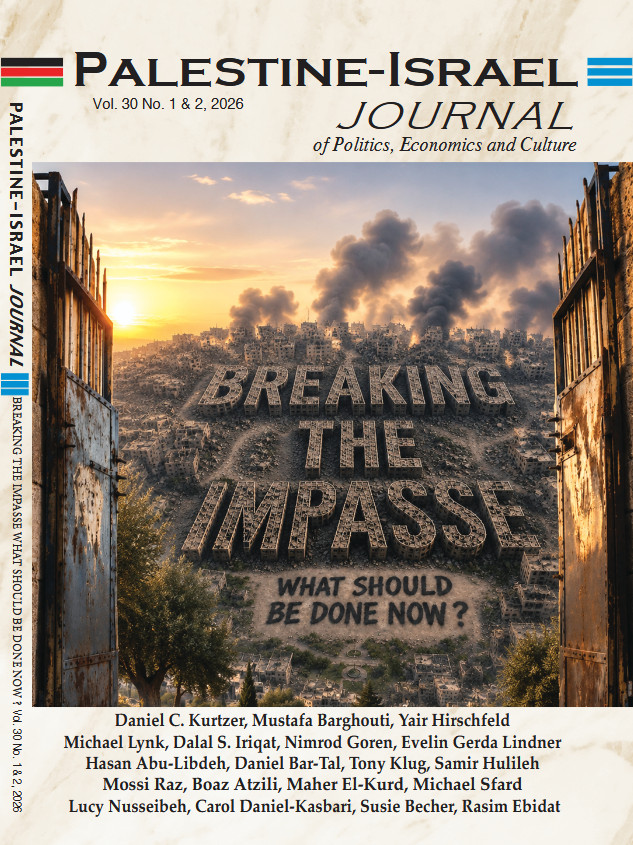
The Israeli-Palestinian conflict is in dire need of progress toward peace. The Hamas terror attack of October 7, 2023, and the subsequent devastating war in Gaza have made this intractable conflict much more entrenched. While local leaders and societies are clearly the prime actors that need to bring about positive change, they can be supported by like-minded international allies.
Among global actors, the European Community (EC), which later turned into the European Union (EU), has traditionally been such an ally and a staunch supporter of the two-state solution. The EC’s 1980 Venice Declaration was among the earliest endorsements of Palestinian self-determination. Ever since, Europe has continued to embrace similar goals and provide multilayered support for their advancement.
The EU’s commitment to the two-state solution sustained years of Israeli-Palestinian stagnation, hardships, and escalations. Nevertheless, the EU’s potential to make policy impact toward such a solution has never been fulfilled. In the grim reality that Israelis and Palestinians are currently living through, there is urgency for effective international support for de-escalation, conflict resolution, and peacemaking. This is a chance for the EU to reassess and fine-tune its role.
To be effective, EU support should be grounded in reality and modest in nature, while being guided by an ambitious forward-looking vision for peace. It should acknowledge challenges and opportunities; take into account the broad set of domestic, bilateral, regional, and international transformations necessary for progress toward peace to be made; be long-term in nature; and highlight the need for local ownership of a future peace process.
This article spells out a set of concrete, actionable, and potentially impactful steps that the EU can take, as of summer 2026, to advance Israeli-Palestinian conflict resolution in each of the key fields related to peacemaking: politics, diplomacy, and civil society.
Politics
Leadership change in Israel is a must for any progress toward peace to happen. Ever since October 7, polls consistently show public dissatisfaction with Netanyahu’s leadership and far-right coalition. In October 2026, Israelis are set to finally have a chance to translate these attitudes into a new political reality.
The current Israeli election cycle, however, is not a typical one. Scenarios predict an unprecedented scope of manipulations, incitement, and intimidation by pro-government circles desperate to cling to power. These might become more evident as the campaign period progresses, on election day, and also in the weeks following it, while attempts to form a new government are underway. A political stalemate necessitating repeat elections could also happen, further prolonging domestic uncertainties.
While political processes should be domestic-driven, the EU can still have a supportive role to play. It should be aware of the unique volatility of the current election cycle, be prepared for political turmoil, and clearly oppose any destructive actions that Netanyahu might take in this context, such as suppressing Arab votes, escalating in Gaza, stepping up de facto annexation in the West Bank, and jeopardizing the elections’ free and fair nature.
In parallel, the EU can highlight to the Israeli public what is at stake in these elections — opportunities that could emerge for Israel should it change course for the better and the negative consequences of the current government’s policies. The EU should also acknowledge that while a “government of change” in Israel will probably be right-wing leaning (within an ideologically-diverse coalition) and will not endorse the two-solution to the Israeli-Palestinian conflict, it will still hold prospects for positive transformations — domestically, regionally, and internationally.
Lessons can be learned from the Bennett-Lapid government of 2021-22 as to what could realistically be achieved. Under that government, Israel-EU relations were revitalized, Israel’s ties with Jordan and Turkey improved, Israel-Palestinian Authority engagement resumed, regional cooperation — also via the Negev Forum — was advanced, extremists were silenced, good governance made a comeback, participation of an Arab party in the coalition took place, and social cohesion was fostered. If somewhat replicated after the upcoming elections, these will be meaningful conditions for making progress on the Israeli-Palestinian issue — even if cautious, gradual, and modest at first — and should be welcome and embraced by the EU.
To make the most out of such an opportunity, should it materialize, preparatory action is needed. The EU can already engage more with political leaders of the Israeli opposition and their advisors (as the United States has reportedly been doing). This will create early links between policy elites that may be working together over the coming years and foster a spirit of cooperation (contrary to the prevailing Israeli approach that the EU is an adversary rather than a friend). The content of such engagements could also feed efforts already taking place within the Israelis opposition to devise concrete work plans and immediate actions for the next government.

Diplomacy
Support for the two-state solution has been on the decline in Israel for a while, and even more so after October 7. A similar pattern is notable also among Palestinians. Realities on the ground and Netanyahu coalition’s actions make the future realization of such a solution more difficult by the day. Nevertheless, a better formula to resolve the Israeli-Palestinian conflict, while addressing national aspirations of both sides, has yet to be presented. And, polls — including the 2026 Israeli Foreign Policy Index of the Mitvim Institute — indicate that if packaged correctly and coupled with broad Israel-Arab normalization, Israeli public support for this solution sharply increases.
Pro-peace Israelis and Palestinians need encouragement from European colleagues to keep up their efforts for a two-state solution. Even if obstacles persist, conditions are unfavorable, and the road is winding, hope and determination should be enhanced. Peace activists do not benefit from constantly hearing international messages about the “death of the two-state solution.” They also do not benefit from hearing “ticking-the-box” messages of support for the two-state solution, which do not acknowledge hardships, do not adapt long-standing policy plans to real-life realities, and are not coupled with meaningful actions to advance such a solution, difficult as it may be.
A step in this direction would be for the EU to concretely prioritize — in its upcoming new Middle East and Security Strategies — the advancement of the two-state solution via a realistic action plan that can help the sides make gradual progress toward a pre-defined final-status agreement. While doing so, the EU can streamline its policies and actions on the file. It should bridge — to the extent possible — long-standing divides between member states and overcome increasing spats between its own institutions (DGMENA and the European External Action Service). Leading such an intra-EU process could be added to the portfolio of Christophe Bigot, the EU Special Representative for the Middle East Peace Process, whose mandate has been extended until February 2028.
The EU should also ensure that diplomatic initiatives in which it is already invested are as effective and impactful as possible. This is true for the Global Alliance for the Implementation of the Two-State Solution, of which the EU is a co-convener. The Alliance, which has been meeting regularly since 2024, is suffering from structural flaws that the EU should work to fix: civil society organizations are not allowed in its discussions (only appearing on side-panels and at receptions), unequal representation of the sides to the conflict (with the Palestinian Authority attending, the Netanyahu government boycotting, and no alternative Israelis invited), lack of collective outputs, and no public domain in which meeting materials are available for the propeace community to utilize, leverage, echo, and further develop. A similar reflection can be carried out regarding the Palestine Donor Group, an EU flagship initiative that somehow overlaps with other multilateral efforts to raise funds for Palestinian state-building and Gaza reconstruction.
Broadly speaking, the EU is challenged by U.S. domination over diplomatic activism related to the Israeli-Palestinian conflict, as well as by the U.S. conduct that deviates from traditional values, practices and mechanisms of conflict resolution, peace mediation, and multilateralism. The EU is critical of this approach, but at the same time seeks to remain relevant and is willing to play along. It struggles to find a niche and to make an impact. A longer-term approach that asserts the EU as a fierce champion of genuine peacemaking processes that address root causes and local needs and advance comprehensive agreements rather than quick fixes and ad hoc arrangements may better serve both the EU as well as Israeli and Palestinian peacemakers.
Practically, the EU can revamp its pre-October 7 initiative to spearhead the development of an international package of peace incentives, which will spell out the benefits of peace to Palestinians and Israelis (a goal included in the 20-point plan). Prior to this initiative’s shelving due to the war in Gaza, both Israel and the Palestinian Authority were willing to engage with the EU on peace incentives. In addition, a proposal on the topic was previously developed by Israeli and Palestinian civil society experts, via the Mitvim Institute, and can serve as a starting point. By doing so, the EU will leverage its added value, inject innovative content into stagnated peace plans, and impact Israeli and Palestinian domestic debates and public attitudes.
Should the Israeli election result in new leadership, the EU will be able to do much more, especially in enabling and fostering engagement between Israeli and Palestinian officials. Various modalities and instruments could be used: launching back-channel engagement between working-level professionals at ministries, as part of EU programs and capacity-building tracks; encouraging regular communication between the Israeli and Palestinian ambassadors to the EU institutions, with EU participation; connecting Israeli and Palestinian parliamentarians via sister party arrangements at the EU Parliament (such as the S&D Group has with both sides); and creating opportunities for Israeli and Palestinian ministers to meet and discuss via high-level EU-led events such as the inaugural Regional Forum for Peace and Security.
The regional dimension, especially the Mediterranean angle — given its geographical proximity, relevance to the conflict, and increased geopolitical importance — also holds potential for constructive EU action. The Action Plan of the newly-launched Pact for the Mediterranean spells out EU-led multilateral initiatives in which both Israel and the Palestinian Authority have expressed interest in taking part. Their implementation can create new regional spaces for practical cooperation. Moreover, regional organizations in which both Israel and the Palestinian Authority are equal members and in which the EU also plays a prominent role, such as the Union for the Mediterranean and the East Mediterranean Gas Forum, could also be leveraged by the EU for similar purposes. Suggestions on how to do so have been introduced by Diplomeds. And, inter-regional connectivity initiatives, such as the India-Middle East-Europe Corridor (IMEC, which the EU pledged to support), could also be linked, with EU support, to Israeli-Palestinian peacemaking, as proposed by EcoPeace Middle East.
Civil Society
Another arena in which the EU can play to its strengths to make much-needed pro-peace impact is civil society. The EU, in its basic essence, acknowledges the importance of NGOs and seeks to integrate them into policyrelevant consultations. The EU is also a major financial supporter of civil society in its neighborhood, including Israeli and Palestinian peace NGOs. EU officials often seek to be “a player, not only a payer.” But, being a payer is a valuable EU role — especially when U.S. peacebuilding funding is dwindling and when European countries are prioritizing investments in their own security needs. Perhaps becoming a “better payer” can be a new EU priority.
Being a better payer entails increased funding for conflict prevention and peacebuilding in the EU’s upcoming Multiannual Financial Framework for post-2027, as advocated by EPLO. It could also entail bureaucracy-thin and organizational support-focused funding streams to Israeli and Palestinian NGOs, which will unlock EU funding for upand- rising organizations, even if lessinstitutionalized and lacking track record in managing large EU grants. This is especially needed post-October 7, as new bottom-up initiatives are being launched, often more accurately addressing local needs compared with well-established NGOs but weak on organizational infrastructure. An example can be learned from Cyprus, where EU peacemaking funding modalities earmarked funds for NGOs applying to the EU for the first time.
In addition, EU funding openings for Israeli and Palestinian organizations should be more frequent than the last EU Peacebuilding Initiative cycles (2023, followed by 2026) — even if allocating smaller funds — to ensure rapid responses to emerging societal needs and changing realities. Within such calls, deeper and more equal partnerships between Israeli and Palestinian NGOs can be advanced by the EU enabling and incentivizing joint leadership of applications, rather than requesting that one organization from either side to the conflict be formally in the lead. Funding proposals of intersectional nature, linking peace activism with other social change causes (e.g. pro-democracy activism) can also be prioritized to bring into the pro-peace constituency audiences that share liberal values but turned hesitant toward peacemaking in the post-October 7 era.
A key benefit of enhanced EU support for Israeli-Palestinian civil society actions will be a gradual reconnect between the two societies. Already a decade ago, the Quartet report called for “increasing interaction and cooperation in a variety of fields” between the sides, but since and especially after October 7 and the war in Gaza, the societies grew further apart. The combination of EU-financed people-to-people projects, EU multinational programs that include both Israelis and Palestinians, such as Erasmus+ and Horizon Europe, and a renewal of successful initiatives like joint study visits of Israelis and Palestinians to the European Parliament, can have a cumulative effect that broadens, legitimizes, and routinizes engagement, undermines critics, and creates future-oriented networks of students, young professionals, and emerging political leaders. This is all missing from the current Israeli-Palestinian landscape.
For cross-border civil society activism to “come back home” and take place locally, the EU can initiate and spearhead the establishment of a dedicated safe space for such activities along the seam line. Here, too, there is a Cypriot example to learn from: the “Home for Cooperation” in the UN buffer zone in Nicosia, which could also serve in the meantime as a meeting space for the multiple Israeli-Palestinian groups that convene in Cyprus due to difficulty to do so closer to home.
Finally, the EU should take action to reverse its civil society-related wrongdoing. In September 2025, when EU Commission President von der Leyen announced the freeze of EU bilateral support to Israel due to the war in Gaza, this paradoxically put a stop to several promising NGO initiatives that advance both Israeli-Arab regional integration and the twostate solution. These initiatives, which were vetted and picked by the EU and clearly aligned with its policy priorities, were halted as their funding originated from an EU budget dedicated to the State of Israel.
Despite repeated statements by EU leaders that civil society will not be impacted by the funding freeze, damage was done. It created an abnormal reality that undermines EU interests and partners, and that prevents some key pro-peace civil society activities from taking place. The EU can exempt pre-selected projects from this freeze so that they can be implemented and foster positive change. In addition, to prevent this from happening again, a new funding scheme for Israel-Arab regional integration is needed, which is purely focused on civil society, clearly linked to Israeli-Palestinian peacemaking, and fully detached from funding provided to state institutions.