
Introduction
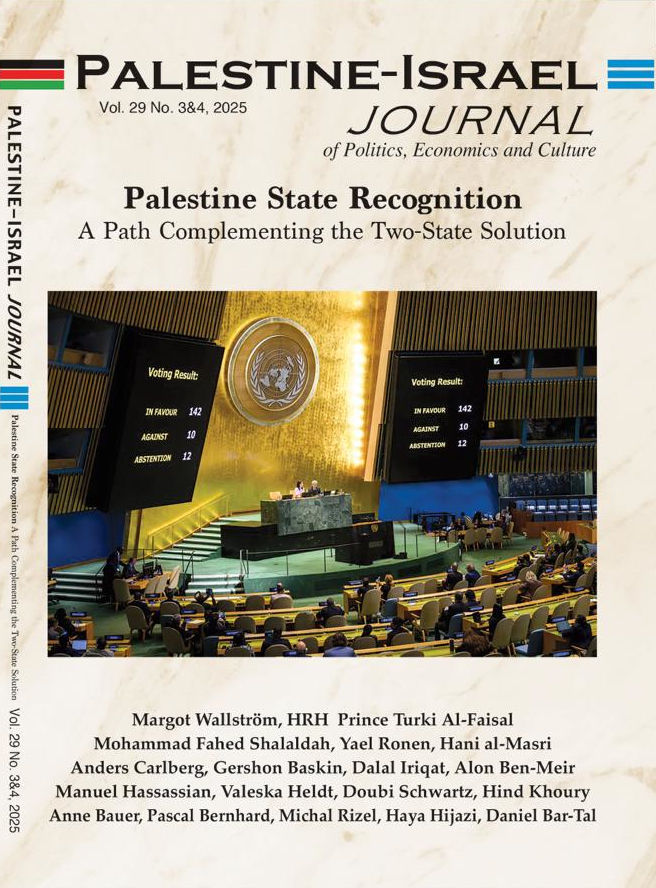
This last year has seen a spate of declarations by Western European and other states of the global north, that they do, or will, recognize the State of Palestine. In the spring of 2024, five European states and four Caribbean states announced their recognition of the State of Palestine. A second wave of declarations is expected to take place in September, with France, the UK, Canada, Australia, Malta, Portugal, Malta and San Marino poised to declare their recognition of Palestine when the UN General Assembly convenes for its annual session.1 International recognition of Palestine will thereby reach over three-quarters of the UN’s 193 member states, encompassing most states in Africa, Asia, and Latin America, and Northern, Central and Eastern Europe.
While Israel claims that the past and future declarations of recognition are a reward for terrorism,2 the states extending recognition emphasize that their action is intended to carve a political path towards comprehensive regional peace based on the two-state solution, by turning the idea of two states from the outcome of a long-awaited political process into its starting point; and to protect the lives of all Israelis and Palestinians. The various declarations, past and future, reflect disappointment with what these states perceived as Israel’s obstructionism.3 The upcoming declarations appear to be also, perhaps principally, a reaction to Israel’s actions in Gaza.4 Be the motivations and goals as they may, the declarations of recognition reveal the weakening of political su112rt for Israel among states that it has long regarded as its moral partners as well as political, economic and even military allies. International recognition in itself, however broad, will not change the fact of Israel’s control over the West Bank or the situation in Gaza. However, Palestine is gradually transforming from a nominal state, “on paper” only, into an active state player in the international arena. Israel is becoming increasingly isolated in its opposition. Moreover, it is not self-evident that such opposition serves Israel’s own interests.
Recognition and Statehood
Under international law, statehood essentially denotes a factual situation, in which a government exercises power independently over a population in a defined territory, and is capable of maintaining external relations.5
Recognition of statehood is a political act, by which existing states acknowledge their view that an entity fulfills the factual requisites. It is fully within the prerogative of existing states, individually, to extend or withhold recognition from aspirant states. Notwithstanding its political character, recognition has legal implications. Some of those are a matter of profound controversy.

Israel objects to the recognition of a Palestinian state on various grounds. It maintains that the Palestinian Authority, which governs the purported Palestinian state, lacks effective control over the territory.6 This argument relates to the fact that important aspects of governance remain in fact in the hands of Israel; to the legal limitations under the Oslo Accords on the powers of the Palestinian Authority; and to the self-contradiction in simultaneously claiming that a Palestinian state exists and that it is occupied, given the essence of occupation is the lack of effective control, while the essence of statehood is its existence.
Notwithstanding the cogency of these arguments, other factors are also at play, among which is the expanding recognition of Palestinian statehood by states. The common view is that when the factual requisites are fulfilled, absence of recognition is not a bar to the existence of a state.7 The case of Palestine raises a converse issue: What are the legal implications of widespread recognition of a state, when the entity in question arguably lacks an effective and independent government?
The Role of Recognition in Bringing about a State in Fact
The debate on whether the Palestinian Authority is an effective government or not is a conversation that goes nowhere: some – indeed, even Israel, in some contexts – point to those spheres of life in which the Palestinian Authority exercises authority to argue that it is an effective government, while others point to other spheres to argue that it is not.
What constitutes “effective” government is ultimately a judgment call. Numerous times in the past, political legitimacy led the international community to be lenient in its assessment of the requisite in the case of territories exercising the right to self-determination, and to emphasize the international commitment to assist these territories in achieving effective government. Prominent examples of this are the recognition of the Congo in 1960, the widespread recognition of Kosovo since its declaration of independence in 2008, and the recognition of South Sudan in 2011. All three have been recognized by the international community as states despite an initial absence of a functioning government. Needless to say, the Palestinian right to self-determination is recognized across the board, including by Israel.8
Moreover, once a new state is recognized, the recognizing state, or the international community more broadly, can assist it in state building without this being considered an improper intervention in the domestic affairs of the sovereign state of origin (in the examples above, Belgium, Serbia, and Sudan, respectively). In the case of Palestine, assisting it would in any case not constitute prohibited intervention, since Israel is not, and does not claim to be, sovereign in the occupied territories (with the important exception of East Jerusalem). Recognition therefore plays an important part in bringing about the fulfillment of the factual requisites for statehood, even if initially they are not met.
Recognition and International Organizations
Palestine enjoys broad international political support, which is not conditional on its status as a state (indeed, much of that support stems precisely from the fact that the demand for a state has not yet been realized). But an important conduit for the practical and material expression of this support, is multilateral institutional frameworks. Membership in those, namely in international organizations, is usually open only to states, and therefore, participation in such frameworks usually depends on recognition of state status.
Palestine’s path to the UN is currently blocked. Admission to the organization is conditional on a decision by the General Assembly upon the prior recommendation from the Security Council. In the latter forum, opposition by any of the five permanent members is enough to thwart a decision. Palestine applied for UN membership in 2011. The Council voted on the matter in April 2024, following a debate in which many Council members considered admission to the UN a means of promoting the two state solution. The UK (and Switzerland) abstained, while France voted in favor of admission, alongside China, Russia, and nine other states.9 The vote failed due to a U.S. veto, cast on the grounds that Palestine does not meet the factual requisites for statehood. The anticipated declarations of recognition will increase Israel’s dependence on the U.S. holding out. And while the latter can withstand international pressure, its willingness to use the veto power is not guaranteed.
Despite the failure to gain admission to the UN, Palestine has been admitted to many international organizations reserved for states only. This followed an unprecedented step taken in 2012, by the UN General Assembly—a body where all states have an equal vote in decision making, and where Palestine enjoys overwhelming support. On November 29, 2012, the General Assembly granted Palestine (the name used by the UN to refer to the PLO since 1988) “non-member observer state status in the UN.” This collective recognition of state status, even if only in the UN, set in motion the procedure regarding the registration of state accession to the hundreds of multilateral treaties deposited with the UN Secretary-General. According to this procedure, the Secretary General must register the accession to a multilateral treaty of any entity that the General Assembly or another UN body has recognized as a State. Based on the General Assembly’s resolution and this procedure, Palestine has joined almost 200 treaties and organizations.
From Nominal Recognition to Judicial Recognition?
In many treaty organizations, Palestine’s membership remains nominal, not least because it does not have full control over its territory. In contrast, within various regimes relating to human rights, Palestine’s membership has had significant legal implications for Israel. Since international human rights law is not based on reciprocity of obligations, Israel’s repeated statement that it does not recognize a State of Palestine and thus has no treaty relations with it10 has failed to gain traction.
Palestine joined numerous universal human rights treaties in 2014, and has even accepted the treaty monitoring bodies’ jurisdiction to hear individual complaints against it. Ironically, in 2023 the Committee on the Rights of Persons with Disabilities (CRPD) found Palestine responsible for violating the rights of two Israeli nationals who were being held by Hamas in Gaza.11 But treaty membership is also a source of power: in 2018 Palestine submitted an inter-state complaint against Israel within the framework of the Convention on the Elimination of Racial Discrimination (CERD), accusing it of maintaining a regime of apartheid in Israel and the territories. Israel rejects the validity of the complaint and its opposability to Israel on the grounds that Palestine is not a state, but the treaty monitoring committee dismissed this position. Notably, the two states that joined Israel in objecting to the Palestinian accession on the grounds that there is no Palestinian state, were Canada and the U.S.12 Now this support is weakening.
By far the most dramatic context in which collective recognition of Palestine as a state has had an impact is in the International Criminal Court (ICC). The Court is empowered to try individuals charged with the commission of international crimes on the territory of a State that has consented to the jurisdiction of the Court, or by nationals of a State that has consented to the jurisdiction of the Court. This move exposed Israeli nationals to prosecution for actions in the Occupied Territories. In this context, too, Israel argues that there does not exist a Palestinian state capable of consenting to the Court’s jurisdiction.13 Israel’s position was so far rejected by the Court’s pre-trial chamber, which has ruled that the 2012 General Assembly recognition resolution enabled Palestine to accede to the Statute of the Court, and consequently, to grant the Court jurisdiction over crimes committed on Palestinian territory or by Palestinian nationals.14 Israel’s view was shared by Canada15 and to some extent by the UK.16 This support now appears to have been lost.
In the International Court of Justice, too, Palestine has initiated moves that are reserved for states.17 If and when the Court decides on the validity of these moves, its determination will have enormous weight, given the Court’s authoritativeness in the international arena. As declarations of recognition amass, the potential grows that the Court would hold that a Palestinian state has come to exist.
Should Israel Continue to Resist the Recognition of a Palestinian State?
Israel’s positions with regard to the status of the West Bank are predicated on the absence, past and present, of a Palestinian state: it claims that the territory is not occupied (at least not under the Fourth Geneva Convention) because it was not taken from a sovereign, and it seeks to legitimize political futures that are not based on the two-state solution.18 Every declaration of recognition increases Israel’s isolation on these matters.
The pursuit of peace and security, which ought to be Israel’s supreme interest, might actually benefit from international recognition of a Palestinian state, provided that Israel acts sincerely towards a negotiated end to the occupation. Recognition of a Palestinian state would render the resolution of the Israeli Palestinian conflict, a matter between equals under international law rather than between an oppressor state and an occupied people. It would force the Palestinian leadership and the international community to honestly address Israel’s genuine security concerns. Sadly, at the time of writing the Government of Israel’s interests seem to be elsewhere, at the expense of the millions of people, both Palestinian and Israeli, under its control.