
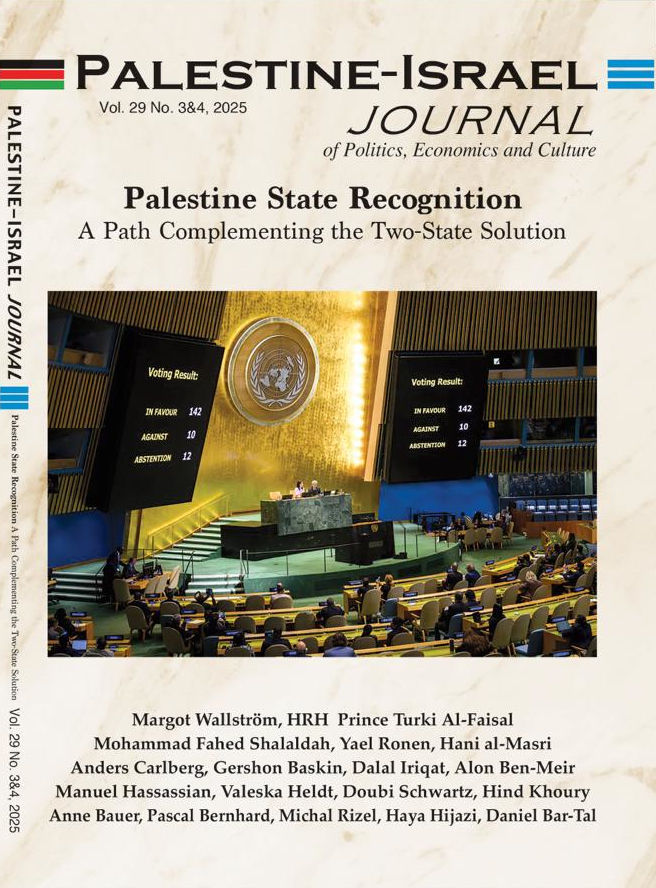
The question of whether the two-state solution is still relevant continues to arise, along with others such as, are there alternatives, what would they look like, and what’s the value of recognition of the State of Palestine by other countries if the two-state solution is no longer realistic. And is the recognition of the State of Palestine merely a declarative statement, or will it serve as leverage to break the deadlock and create a genuine two-state solution. These are the issues we address in this special issue of the PIJ with very distinguished international, regional, Israeli, and Palestinian experts.
The principle of the two-state solution — one Jewish and one Arab — is embedded in UN General Assembly Resolution 181 of November 29, 1947, known as the Partition Resolution, which laid down the international legitimacy foundations for the creation of the State of Israel in 1948, on the territory designated to be the Jewish state in accordance with that resolution. Israel, however, took over additional territory from what was designated to be the Palestinian state, and from the international zone of Jerusalem that was to be under a special international regime administered by the United Nations rather than part of either of the proposed Arab or Jewish states.
Since 1948, the Palestinians have been struggling to achieve their state, at first from the Jordan River to the Mediterranean Sea through the denial of Israel’s right to exist and later on the basis of the two states. This change came about in November 1988 when, having become more realistic, the Palestinian National Council officially adopted the two-state solution.
The current extremist right-wing Israeli Government is giving a free hand to Bezalel Smotrich, head of the Religious Zionist Party, finance minister, and at the same time minister in the Defense Ministry in charge of the occupied territories. In this capacity, he is investing huge financial resources to expand existing settlements, authorize new ones, integrate the West Bank infrastructure into Israel, and appoint settlers as officials to run the daily affairs of the Palestinians in the West Bank. These officials use their power and authorities to grab land and destroy houses, groves, and farms while covering up and backing settler terror against Palestinians, undermining the possibility of a two-state solution.
The genocidal Gaza war and the plans to deport more than 2 million Palestinians from the Gaza Strip to other countries, together with the atrocities and violent practices of the settlers and the IDF in the West Bank and the threats to do in the West Bank what is being done and planned to be done in Gaza, have raised fears and concern in many countries in the world. They have started to act against the war in Gaza and against the plans for massive deportation of Palestinians, seeing them as a major threat to regional stability and security.
This international development is crowned by a French-Saudi initiative supported by several European and other countries, calling for recognition of the State of Palestine and the revival of the two-state solution.
We at the Palestine Israel Journal have been supportive of the two-state solution since our very beginning in 1994, because we believe that it still has the support of the majority of the Israeli public, the Palestinian public, and the international community. At the same time, we realize that the settlement project is designed to kill this option.
With today’s realities on the ground, a Palestinian state cannot arise unless there will be a leadership in Israel capable of evacuating settlements from the heart of the occupied Palestinian territory and create through a minimal, agreed upon land swap as was suggested in what is known as the Clinton parameters of December 2000. If the Israeli people cannot produce such a leadership, it should be the outcome of serious international pressure by all possible means, including both economic and political.
If this doesn’t happen, we will remain with ongoing fierce violence and victims on both sides and an apartheid regime in the West Bank that is spilling across the Green Line into Israel proper.
This situation cannot go on forever. Ultimately, as a result of international opposition to apartheid and possible sanctions against Israel, the Zionist project and the idea of a Jewish state will come to an end and, after decades of bloodshed, suffering, and destruction, might eventually lead to one democratic state for all.
The international campaign to recognize the State of Palestine is a golden opportunity which should be grabbed and reinforced through an immediate ceasefire in Gaza, hostage release and exchange of prisoners, an end to the war, and reconstruction of Gaza. All of this must be accompanied by a political process to resolve the conflict on the basis of the Arab Peace initiative of 2002, leading to the realization of the two-state solution through the establishment of the State of Palestine along the June 4, 1967 lines.