
The Palestine-Israel Journal is a quarterly of MIDDLE EAST PUBLICATIONS, a registered non-profit organization (No. 58-023862-4).
Bookmark and Share


Editorial Board

Hisham Awartani

Danny Rubinstein

Sam'an Khoury

Boaz Evron

Walid Salem

Ari Rath

Zahra Khalidi

Daniel Bar-Tal

Ammar AbuZayyad

Galit Hasan-Rokem

Khaled Abu Aker

Galia Golan

Nazmi Ju’beh

Gershon Baskin

Edy Kaufman

Ata Qaymari

Benjamin Pogrund

Nafez Nazzal

Simcha Bahiri

Nadia Naser-Najjab

Dan Jacobson

Jumana Jaouni

Dan Leon

Anat Cygielman

Khuloud Khayyat Dajani

Izhak Schnell


Vol.13 No.3 2006 / Hamas and Kadima
Are They Up to the Challenge?

Focus

Hamas and Palestinian Religious Moderation

Palestinians have always adhered to a moderate brand of Islam.

     by Mohammed Dajani

A key question raised in the aftermath of the Islamic Resistance Movement’s (Hamas) victory in the Palestinian Legislative Council (PLC) elections of January 20061 is how to interpret such a victory in free and democratic elections? Could it be interpreted as a shift towards fundamentalism on the part of the Palestinians? Have the Palestinians turned their back on a Fateh-style secularism and religious moderation to embrace instead religious radicalism? Or could it be that the Palestinian people, in their search for identity, have decided to opt for religious, rather than national, identity?

Palestinian Religious Journey
Since their early history, the Palestinians have been adhering to a moderate brand of Islam called al-Wasatieh (the “middle-way”), which is neither radically fanatic nor totally secular. Under the British Mandate, Muslims, Christians, and Jews lived in a tri-religious society. The communal conflict at the time was not religious — Muslims against Jews — but rather political: Arab nationalism clashing with Zionist aspirations to create a Jewish state in Palestine.
The Islamic movement in Palestine began in the 1950s as a religious organization. Its original aim was the reform of society, but in the 1990s, it grew into an Islamic resistance movement against the Israeli occupation. During the 1950s and 1960s, the Arab world witnessed an upsurge of religious fervor unleashed by the Muslim Brotherhood on the one hand,2 and Communist Party activities on the other. The Muslim Brotherhood (al-ikhwan al-Musilmeen) was founded in Egypt by Hassan al-Bana. It was imported into Palestine in 1947 by Palestinians studying in Egyptian universities. They went home enthusiastic to spread their dream to create an Islamic society based on Islamic principles and Islamic shari’a. However, this call did not receive the expected mass support among the Palestinian people. A clash erupted within the Arab world at large between the national Arab movement, viewed as progressive, and the religious Islamic movement, viewed as reactionary. Nationalism assumed predominance, particularly with the rise in popularity of Egyptian President Jamal Abdel Nasser in the Arab world in the aftermath of the 1956 Suez Crisis.
A group seceded from the Muslim Brotherhood in 1953 to form the Islamic Liberation Party (Hizb al-Tahrir al-Islami), a political entity whose aim was to establish an Islamic caliphate through the political indoctrination of their members. Its ideological focus, which lacked any practical measures to affect the daily life of the faithful, resulted in few adherents and limited popular support. According to its views, the establishment of the Islamic state took priority over jihad to liberate Palestine from Israeli occupation. It called for the revival of the Islamic way of life by fostering the education of the individual Muslim, the Islamic family, and the Muslim society to eventually bring about a Muslim state. According to their teachings, only after the Islamic state is established will its main mission be to liberate Palestine.
In contrast, the Islamic Jihad (al-Jihad al-Islami), advocates armed struggle for the liberation of Palestine, and considers the struggle against occupation as an official duty for all Muslims. However, it provided no social, medical, or educational services to assist the Palestinians in their daily hardships, and so has failed to muster much mass support.
Thus, it can be said that in Palestine, religious currents run the spectrum from extreme left to extreme right. On the left, there are the extreme secular groups represented by such movements as the Popular Front for the Liberation of Palestine (PFLP), the Democratic Front for the Liberation of Palestine (DFLP), and the Communist Party. On the right, there are the orthodox religious groups represented by Islamic movements, such as the Islamic Resistance Movement (Hamas) and Islamic Jihad Palestine. And in the center, there are the moderate secular groups, represented by the Palestinian National Liberation Movement (Fateh). Using middle-ground slogans, Fateh captured and dominated the Palestinian political scene from the mid-1960s until January 2006, when Hamas acceded to power.

The Hamas Movement
The question that arises then is: How has Hamas succeeded in making its historic breakthrough when the Muslim Brotherhood and other Islamic currents have remained peripheral in Palestinian society? One reason could be that, unlike the others, the agenda of Hamas includes not only religious but earthly matters as well, such as the provision of food, education, health care, and social services to the people.
The Palestinian Islamic awakening began in the early 1980s — climaxing with the beginning of the first Intifada in November 1987, which resulted in the creation by Sheikh Ahmad Yassin of the Islamic Resistance Movement (Hamas) as an Islamic jihadist organization. Its military wing is known as the Legions of Izz Eddin al-Qassam (Kataeb Izz el-Din al-Qassam).3 In its first communiqué issued on November 15, 1987, Hamas took upon itself to vehemently resist the Israeli occupation through armed struggle. It called for the liberation of Palestine through jihad. Slowly, this religious movement started to make inroads in community councils and union elections, so much so that in 1992, its leaders and supporters were deported by Israel to the Lebanese borders at Marj al-Zuhur.

The main ideological tenets of Hamas are the following:
* Hamas is a resistance movement whose aim is the liberation of Palestine; it is not a political party focused on taking over the government.4
* Hamas considers the struggle for the sake of God (al-jihad fi sabeel ellah) the fight for liberation, as the major element in resisting the Zionist occupation of Palestine. It casts doubt on efforts to achieve Palestinian rights through peaceful means.
* Mandatory Palestine in its totality is an Islamic waqf that is not negotiable or divisible, or for surrender in part or in toto. Any concessions related to this land are forbidden by religion, and its liberation is a duty for all Muslims — male and female.
* Secularism does not constitute a meeting point with the Islamists.
* Palestinians are the spearhead for the resistance against the Zionist enemy. However, all Arabs and Muslims everywhere are required to join the jihad to achieve the goal of liberation.

The Legislative Elections of 2006
During the months preceding the Palestinian municipal and legislative elections, the political and economic situation of the Palestinians was growing worse by the day. The continued expansion of Jewish settlements in the West Bank, the separation wall, which cuts off about 10% of the West Bank, and, finally, the unilateral disengagement from the Gaza Strip, all helped to exacerbate the situation on the ground and paved the way for Hamas to assume political power.
In the party lists elections, Hamas won with only a slight majority. This would suggest that the majority is not so far-removed from Fateh in their political direction — two states alongside each other and peace with Israel. Many of the votes that went to Hamas had nothing to do with religion and fundamentalism, but were more a protest against the occupation, corruption, and a desire for change. The military operations carried out by Hamas against Israeli targets, the glorification of the martyrs, and Israel’s subsequent response in the form of collective punishment gave Hamas great popular support in the Palestinian street. The perception among Palestinians was that the Fateh leadership did not care much about them, and so Fateh was generally blamed for all the ills in Palestinian society. The efforts of the Palestinian Authority (PA) to suppress Hamas backfired, resulting in its isolation and a decline in its popularity.
Hamas reached the government through a democratic process. Now they have to prove themselves vis-à-vis their people by shouldering the responsibility for their welfare and well-being. The international community expected that the realities of governing and the need to provide security, jobs, and food to the people would eventually steer Hamas in the direction of meeting the requirements of the international community, namely, recognizing Israel’s right to exist, denouncing terrorism, and agreeing to a negotiated process.5
So far, Hamas has failed to think creatively, causing it to lose much of its popularity and popular support. What went wrong?
1. The PA is to blame for having allowed Hamas, an organization that did not adhere to the principles and agreements of the peace process, to participate in elections planned within the Oslo Accords framework.
2. Having won the elections, Hamas should have abided by its election platform, which called only for “reform” and “change” and did not include the slogan of “liberation.”
3. In forming the Palestinian government, Hamas should have opted for a “national” government with a national agenda, instead of forming a Hamas government with a Hamas agenda.
4. Hamas should have made a distinction between its political aspirations as a religious party and the national aspirations of the Palestinian people. Upon assuming power, it should have stated that, as a Palestinian national government, it recognizes the State of Israel and accepts the agreements signed under the Oslo peace process. Additionally, it should have recognized all the agreements signed by its predecessors in accordance with international law. By failing to do so, Hamas put itself on a collision course with the international community.

Conclusion
The very fact that Hamas participated in elections that are based on the Oslo agreement proves that the Palestinian political system is moving towards the center. On the face of it, the Hamas victory appears detrimental to the peace efforts. However, the actual result may turn out to be more positive:
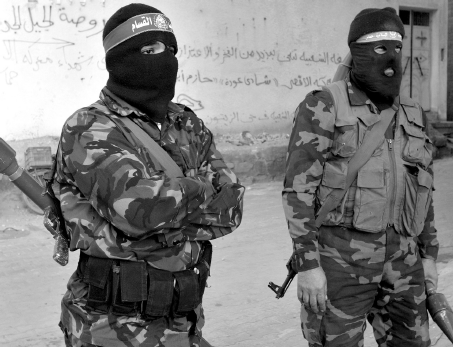

Hamas military wing - The road to take is negotiation, not confrontation.

Itmight work as a moderating influence on the other radical movements and ensure the stability and permanence of any agreement that is concluded.
The “two states for two peoples” formula remains the only option for achieving peace. A two-state solution to the conflict requires all participants in the democratic process to renounce violence and terror, to recognize each other, and to respect the right of the other to live in peace. However, this cannot be achieved unless both parties resume negotiations and the Israelis accept the fact that Hamas is an integral part of the Palestinian social and political fabric.
Failing this, what road should the Palestinians take to get out of the present crisis? It is time for a new party to emerge that would draw the best and the brightest from among the Palestinian people. The new party should adopt the Wasatieh Islamic tradition and the shura Islamic concept as its main pillars. Al-shura advocates collective and consultative decision-making.
Al-Wasatieh calls for Muslims to take a middle ground between those who sanctify tradition and those who opt for rational thinking in reading and explaining the Holy Qur’an in compliance with the Surah in the Holy Qur’an: “And so we have created you a halfway nation.” Or in the verse: “Be neither miserly nor prodigal, for then you should either earn / reproach or be reduced to penury.”
The goal will remain the establishment of a Palestinian state with East Jerusalem as its capital, as stipulated by the Oslo Accords. The road to take is negotiation, not confrontation.


Bibliography
Abu-Amr, Ziad. Islamic Fundamentalism in the West Bank and Gaza. Bloomington: Indiana University Press, 1994.
Dreyfuss, Robert. Devil’s Game: How the United States Helped Unleash Fundamentalist Islam. New York: Metropolitan Books, 2005.
Gordon, Haim, Rivka Gordon & Taher Shreteh. Beyond Intifada: Narrative of Freedom Fighters in the Gaza Strip. London: Praeger Publishers, 2003.
Human Rights Watch. Erased in a Moment: Suicide Bombing Attacks against Israeli Civilians, Human Rights Watch, 2002.
Mishal, Shaul and Avraham Sela. Hamas: A Behavioral Profile. Tel Aviv: Tel Aviv University, The Tami Steinmetz Center for Peace Research, 1997.
Shaked, Roni and Aviva Shabi. Hamas: Palestinian Islamic Fundamentalist Movement. Jerusalem: Keter, 1994.

Article Comments
1 - thanks
MOHD FYROZ | INDIA | 09:16:56(Jerusalem)
i am from india. here my thanks for the article because i got knowledge about the hamas group which i think as the heroes of the islamic world.
thank you for the article.

fyroz mohd
india

2 - International Religious and Spiritual Leader H.E. Shah Sufi Saleh Uddin Ahmed Chisty Gives A Clarion Call to Establish the Religious Brotherhood on the light of Abrahamic Faith.
Shah Sufi Saleh Uddin Ahmed Chisty | Bangladesh | 05:26:58(Jerusalem)
ATTN: News Editor
Press Statement

International Religious and Spiritual Leader H.E. Shah Sufi Saleh Uddin Ahmed Chisty Gives A Clarion Call to Establish the Religious Brotherhood on the light of Abrahamic Faith.

“The patriarch of all the believers of Allah (God), i.e. Jews, Christians, and Muslims is Prophet Ibrahim (Peace be upon him, Abraham, PBUH). He built the Kaaba in Makkah with his first-born son Ismael (Peace be upon him, PBUH). This was an order from Allah (SWT) that Ibrahim and Ismael (PBUT) construct this Holy House of Allah (SWT) as a place of worship for all the believers on earth. Ismael (Peace be upon him, PBUH) was 17 at the time he and his father built the Kaaba. Prophet Muhammad (Peace be upon him, PBUH), a descendent of the Prophet Ismael (Peace be upon him, PBUH), would come nearly 2,500 years after Kaaba was built and reunify it as a holy place of worship, according to the teachings of the Prophet Ibrahim (Peace be upon him, PBUH). As stated in the Torah and in the Holy Quran "all the generations will be blessed through Ibrahim (Peace be upon him, PBUH)" (Genesis 12 and 18 Holy Bible, Chp 2 Verses 123-141 Holy Quran).”

Dear Religious and Spiritual Leaders,

I wish to plead and make a fervent call to all my brothers/sisters across the world through the courtesy of this letter in carrying forward, upholding the message of Allah (God), His love for mankind, and ensuring lasting peace in a troubled world. The purpose of portraying my call upon all revered world leaders, politicians, and heads of states, policy makers, academicians, and civil society, spiritual and religious leaders is aimed at removing mistrust, misunderstandings the world is unnecessarily obsessed with, we have to liberate the world of undue tensions and wrangling.

My dear revered brothers and sisters, I have been working tirelessly for establishing peace for nearly twenty-five years. We are definitely running out of time. Everyday a large number of innocent lives are taking their toll for no fault of their own. This has to be arrested. The burning question is how this can be arrested? We can only achieve this by arriving at a common consensus and share our noble vision, thoughts, pooling our energy, resources, dialogs based on religious and spiritual concepts together on one common platform and thus thrust all our force in that direction without further wastage of time. Our Holy Books and Scriptures are the source of eternal light to erase all such misconceptions and misgivings. These sacred books as ordained by Allah (God) are irrevocable. It is enshrined and has come to us as an eternal source of strength, driving force sent through our Holy prophets at different times for the betterment of mankind. Unfortunately, we have not been able to use and exploit this to our advantage, as was the enlightened desire of Allah, through His Divine prophets. We are potentially still a force to reckon with on the driving seat to harness our good virtues for the peace of the world.

It is therefore imperative, I feel, that concerted effort needed to renew our honest will to establish the doctrines of Allah in this world, in thoughts, words and deeds, if not we are bound to perish and vanish from the good book of Allah. Politicians, policy and lawmakers and religious leaders of all faith, belief has to work in close conjunction in order to materialize our dream for a world of progress and prosperity. My thoughts go out for the oppressed and the depressed. It is true, many thought provoking, peace loving individuals, groups are working in reducing tension and conflicts, but unfortunately not much has been achieved. It is only through the doctrine of preaching love and respect for families under Allah (God) and the teachings of His innumerable prophets that were sent for the welfare of mankind at different times can bring about welfare, happiness of mankind.

Followers of the Abrahamic faith having one common ancestral root in fact preach love and peace, religious harmony, having sprung from one land. This indeed is a big boon and blessing that we can be proud of. It is time for reality and not rhetoric. It is through this vehicle that we can effectively mobilize our engine together by bringing the Abrahamic faith of all religious faiths together for establishing lasting peace. I have been running all over the world relentlessly making sincere effort to preach the ideology of Islamic Sufism as enunciated and preached by our Holy prophet Hazrat Mohammad (Peace be upon him, PBUH) who inherits the fundamentals of Hazrat Abraham (Peace be upon him) as are also firmly rooted in the common ideology of our Jews and Christian brothers.

I am convinced that we can march forward in our common goals and gospel without further delay, in fostering synchronization on the principles of our common glorious heritage. I would like to make a call upon all world leaders to form a consensus to ensure that this can be established. Unfortunately in recent years, Islam has been widely misunderstood and there lies one of the saddest tragedies of our contemporary world. We believe that our prophets who had all been sent and ordained by Allah were His peaceful messengers for the spread of fraternal brotherhood and live in peaceful coexistence.


Sincerely,


Shah Sufi Saleh Uddin Ahmed Chisty
Religious and Spiritual Leader.
International President,
Publication and Co-ordination Centre of Islamic
Ideology and Sufi-ism (PCCIIS International).
-In consultative status the with ECOSOC and
Associated with DPI of the United Nations.
Website: www.chistypcciis.org

3 - H.E. Shah Sufi Saleh Uddin Ahmed Chisty Calls for handing over the Muslim holy sites to a neutral body.
Shah Sufi Saleh Uddin Ahmed Chisty | Bangladesh | 05:37:11(Jerusalem)
On the eve of holy hajj-His Eminence Hazrat Shah Sufi Saleh Uddin Ahmed Chisty --- the founder chief of the UN affiliated International Organization The Publication and Co-ordination Centre of Islamic Ideology and Sufi-ism (PCCIIS International)’ --- has said the issue relating to Al-Aksa Mosque is not a problem of Palestine and Israel, rather its is a global one.

“So, the problem should be solved in the light of religion with a view to maintain harmony among the concerning religious groups towards the establishment of long-lasting global peace,” he asserts.

Leaders of Jews, Christian and Muslim communities must come forward to resolve the long-pending issue since the holy site is important to all the three religious communities, he added.

Shah Sufi Saleh Uddin Ahmed Chisty, who is vocal against all sorts of human rights violation across the world, didn’t even hesitate to be critical of the anti-human rights activities being carried out by the Government of the Kingdom of Saudi Arabia (KSA).

H.E. Shah Sufi Saleh Uddin Ahmed Chisty is also engaged in upholding United Nations development programs, including the MDG, UN decade for human rights education, poverty alleviation and campaign against women trafficking.

Earlier, Mr. Chisty, in a deliberation at the 57th session for the commission on human rights that was held in Geneva on April 21, 2001, also gave a clarion call to the KSA Government to hand over the management of the Muslims holy sites of the holy Kaaba and Mosjid-e-Nabbabi to a global-body comprising top religious and spiritual leaders from Muslim dominated countries.

Addressing the session, he pointed out that the Christian community across the world set an example through establishment of the Vatican-city under the care of a pope the topmost religious and spiritual leader of the Christian community, supported by religious & spiritual leaders of the Christian world.

During his speech, Shah Sufi Saleh Uddin Ahmed Chisty cited some holy Quranic verses and asserted that kingship is not allowed in the Islam. He raised these points, not only attesting the rights of Islamic nation, but also for consolidating the global people by curbing terrorism which is being nurtured across the world by the Saudi Government in the name of Islam.

Mentionable, H.E. Shah Sufi Saleh Uddin Ahmed Chisty always preaches strongly that proper preaching of the Sufi-thought can help immensely in bringing the world peace and communal harmony. The spiritual leader is very much in touch with the world leaders in solving different global issues.

4 - Palestinian-Israeli conflict deserves quickest solution for the sake of world Peace.
Shah Sufi Saleh Uddin Ahmed Chisty | Bangladesh | 21:28:34(Jerusalem)
Palestinian-Israeli conflict deserves quickest solution for the sake of world peace.

The ongoing Palestinian-Israeli war has taken a bade shape that has so far left at least 1200 Palestinians and 10 Israelis dead in the Hamas-controlled Gaza, where Israel has been bombing for the last couple of weeks without caring the rest of the world, even the United Nations.

The U.N. General Assembly President has termed the Israeli attack in Gaza as genocide and the U.N. Secretary General has called for an immediate ceasefire there to end inhuman killing of unarmed children and women. However, it is not clear when and how the United Nations is going to implement it.

Meanwhile, according to different media some 700 children and women have been killed and many wounded most of them might become crippled. Moreover, humanitarian activities have become difficult or impossible in the Gaza strip, television and radio reports stated. News analysts suspect that Israel, despite protests in different parts of the world, has been continuing the inhumane attack aimed at the apparent psychological breakdown of the Palestinians. And there is no sign of a backward march of the Israeli military side at all.

Israel says they are continuing the war to neutralize Hamas and stopping them from triggering rockets into Israel. While the latter states that they are compelled to fire rockets to end the control of Gaza by Israel and humanitarian crisis there. However, the Israeli side claims that there is no humanitarian crisis as such in that area and refuses to end the control of Gaza to compel Palestinians to bow down to the Israeli government.

As a result of the intense fighting between Israel and Palestinians in Gaza, the entire Muslim, Jewish and Christian world has sharply reacted mainly owing to their religious attachments to the disputed land. That’s why thousands of people of these communities, all of who are sons of Abraham (Peace be upon him), have demonstrated across the world to stop the war.

The war has left manifold impact on the international politics, because of that Muslims across the world have been condemning the Egyptian government for not helping Palestinians by giving them shelter. Similarly, neighboring nations of Jordan and the Kingdom of Saudi Arabia have been facing harsh criticism. These so-called Muslim nations are doing so mainly to protect their own power. The same is the case with other Muslim nations, as they fear that the super powers might declare them as terrorist-country. As a result, the entire Muslim world has failed to extend their real cooperation towards resolving the Palestine-Israel conflict. On the other hand, the super powers are lingering on the issue to materialize their own interests maybe they are using the Palestine-Israel conflict to gain some thing else. Moreover, the United Nations has proved itself as a powerless body as it could not bring any substantial result towards establishing long lasting peace in the conflicting land as it happened in other parts of the world.

We think that if the United Nations continues to play such a role, the body will not exist in near future. So, it would be the duty of the current U.N. Secretary General to take a clear and strong stand to reach a permanent solution – let the General Assembly and Security Council decide which is the best solution. If the U.N. representatives of the world fail to achieve it soon, the entire world including the super powers would be in trouble.

Because, now it is clear to all, that counter-terrorism to curb terrorism cannot be the solution. Rather, the parties concerned should concentrate on a unanimous political solution that can be accelerated with the help of Religious and Spiritual leaders since the issue concerns three religious communities – Muslim, Jews and Christian.

Thanking you,


(Shah Sufi Saleh Uddin Ahmed Chisty)
International President and CEO,
Publication and Co-ordination Centre of Islamic Ideology and Sufi-ism(PCCIIS International).
Website: http://www.chistypcciis.org

5 - PCCIIS Chief His Eminence Shah Sufi Saleh Uddin Ahmed Chisty greets US President H.E. Barack Hussain Obama
His Eminence Shah Sufi Saleh Uddin Ahmed Chisty. | Bangladesh | 07:16:44(Jerusalem)
Dear Mr. Barack Hussein Obama,

I am Shah Sufi Saleh Uddin Ahmed Chisty, International President of the United Nations affiliated international human rights organization PCCIIS.

I congratulate you for becoming the President of USA as well as for selecting Hillary Clinton as the Secretary of State. I am very happy because I was engaged directly and indirectly in your election campaign and do remember relentless efforts of all of your team members including former President Bill Clinton and Hillary Clinton for keeping frequent contact with me in pre-election days. Hope, our relation and bond of friendship will be strengthened in the coming days as well.

On the occasion of your Presidential Speech along with the first interview with the press, I greet you for your plan towards establishing world peace and justice and religious-brotherhood, taking into consideration the mistakes made by US administrations including that of Bush.

Now, you yourself have also realized that the U.S. invasion in Iraq was wrong that has not only damaged the image of USA but also left thousands of Iraqis and numerous U.S. soldiers dead. The Bush Administration made many mistakes as such in the name of curbing terrorism. However, Mr. Bush said that he gave the directive of the attack in Iraq on the basis of U.S. intelligence report on nuclear weapons, which we think cannot be concocted as he claimed later on. Incidents as such deserve reinvestigation; otherwise rationality of such steps will remain foggy for ever. I think your administration will remain vigilant in safeguarding you from making such self-damaging mistakes that have shattered the bright image of the USA.

Whatsoever, I appreciate your determination to regain the prestigious image of the USA in the whole world including Middle East. I also support your suggestion for solving the Israel-Palestine conflict through diplomatic efforts and bilaterally in particular. Hope, long-lasting peace will be established in Gaza and other parts of the Middle East and the rest of the world during your tenure. We also expect that your administration will take timely measures against all sorts of racial discrimination as well as communal repressions.

Moreover, I hope that, under your strong leadership, the United Nations will be revitalized in the sense of neutrality and boldness. The United Nations, which was founded following World War II, has almost become inactive. I believe you will be able to take pragmatic steps in reshaping the United Nations that was created for a noble objective of establishing peace in the world shunning the path of war and destruction.

Last of all, I wish your all out success in tackling domestic and international problems as early as possible by the grace of the Almighty Allah. I am very much optimistic about your success due to your tenacity, foresightedness and zeal for establishing peace and justice in the world.

May Allah bless you,

Website: http://www.chistypcciis.org

Add your Comment:
Your name:
Your Email:
Your Country:
Title:
Comment:
Note: The contents do not represent the position of the PIJ, but only those of the authors.


 © 2010 Palestine-Israel Journal. All Rights Reserved. Articles, excerpts, and translations may not be reproduced in any form without written permission.
The Palestine-Israel Journal gratefully acknowledges the support of UNESCO for the initial development of the website.
The Palestine-Israel Journal gratefully acknowledges the support of the European Union for the maintenance and development
of the website.